Hove Shockwave Blog


Shockwave Therapy vs Steroid Injections: Which Is Better for Tendon Pain?
By Dr Lewis Kingsnorth DC MChiro (GCC Reg. 3359) — Hove Shockwave, 82 Goldstone Villas, Hove
Quick answer: Steroid injections usually give faster short-term pain relief, but research on tendon problems consistently shows the benefit tends to fade — and outcomes at six to twelve months are often no better, and sometimes worse, than other approaches. Shockwave therapy works more gradually, aims to stimulate the tendon's own repair process rather than suppress symptoms, and is recognised by NICE for several tendon conditions with no major safety concerns. For most persistent tendinopathies, a non-invasive, repair-focused approach is a sensible option to consider before, or instead of, repeated injections — but the right choice depends on your diagnosis, which is why every treatment decision should start with a proper assessment.
Why people end up choosing between the two
If you have been struggling with a stubborn tendon problem — plantar fasciitis, tennis elbow, Achilles tendinopathy, jumper's knee or pain on the outside of the hip [editor: link each to its article] — there is a good chance someone has already suggested a steroid injection. It is one of the most common treatments offered for tendon pain in the UK, and for decades it was more or less the default next step when rest and over-the-counter pain relief had not worked.
More recently, extracorporeal shockwave therapy (ESWT) has become the other main non-surgical option, and it is now one of the questions we are asked most often at our Hove clinic: “Should I have shockwave therapy or just get the injection?” The honest answer is that they are very different treatments trying to do very different things — and understanding that difference makes the decision much easier.
How a steroid injection works — and the catch
A steroid injection — provided by a GP or hospital consultant, not by our clinic — works by strongly suppressing inflammation in and around the painful area. When genuine inflammation is driving the pain, it can work quickly and impressively — many people feel substantially better within days.
The catch is that most long-standing tendon pain is not primarily inflammatory. Research over the past two decades has shown that chronic tendinopathy is better understood as a degenerative and failed-healing problem: the collagen structure of the tendon becomes disorganised and the tissue struggles to repair itself. That is why the research picture for steroid injections in tendinopathy is so consistent — and so sobering:
- Short term: injections typically outperform other treatments for pain relief in the first few weeks.
- Medium to long term: randomised trials in conditions such as tennis elbow have found that people
- who had steroid injections often did worse at six to twelve months than those who had physiotherapy or even no active treatment, with higher rates of recurrence.
- Repeated injections: steroid injections can weaken tendon tissue over time, and repeated injections are associated with a small risk of tendon rupture. Around the heel, additional risks include thinning of the protective fat pad and, rarely, rupture of the plantar fascia itself.
- None of this means steroid injections are “bad” — they remain a genuinely useful tool in the right situation. It means they are a symptom-relief tool, not a repair tool, and for a degenerative tendon problem that distinction matters a great deal.
- How shockwave therapy works
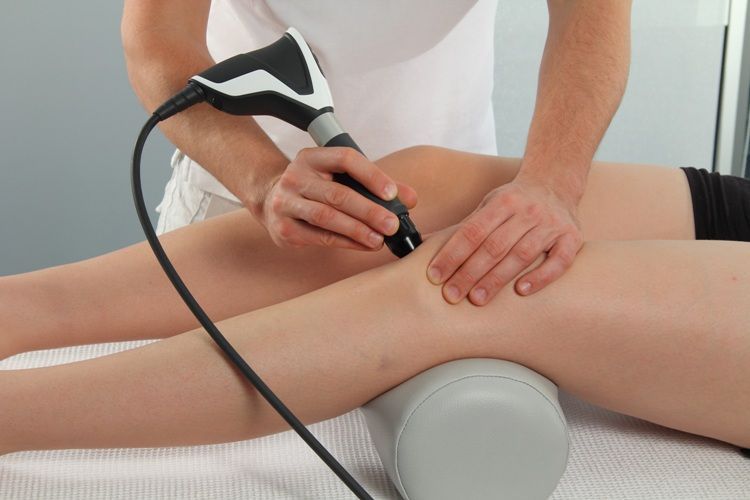
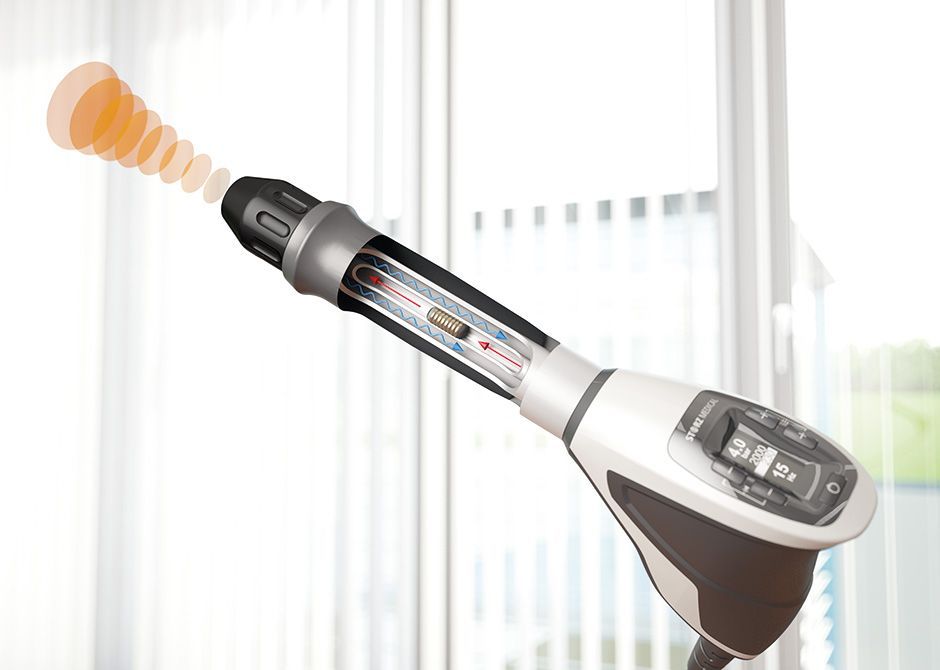
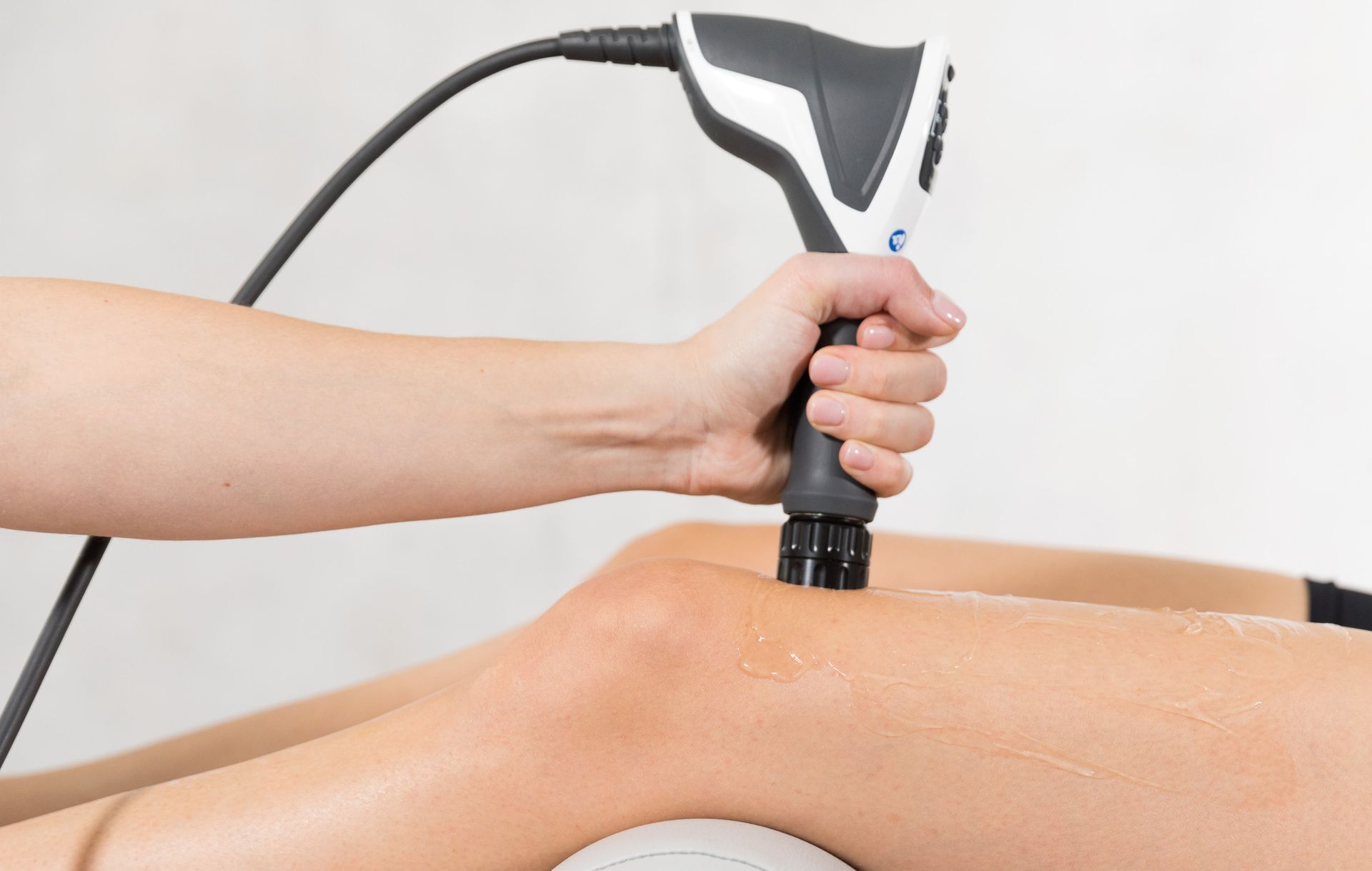
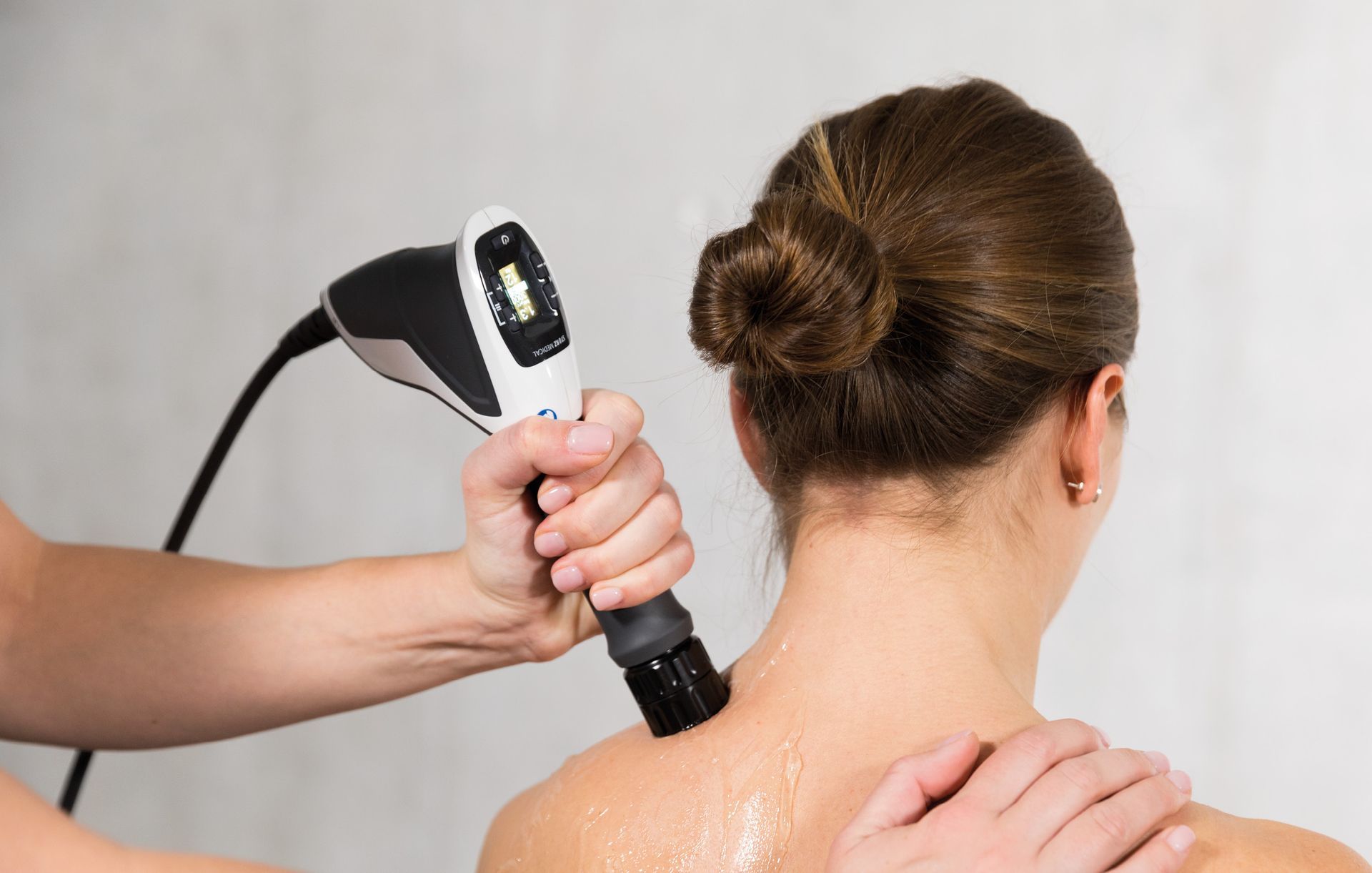
- Shockwave therapy takes the opposite approach. Instead of suppressing symptoms, it delivers focused acoustic pulses into the affected tissue to stimulate the body's own repair response — increasing local blood flow, encouraging new vessel formation, reactivating stalled healing in the tendon and modulating the nerves that transmit pain.
- A typical course involves three to six short sessions, usually a week apart, with no needles, no medication and no meaningful downtime — most people walk out and carry on with their day. Shockwave therapy is recognised in NICE guidance for conditions including plantar fasciitis and Achilles tendinopathy, with no major safety concerns identified when delivered by a trained clinician.
- In our experience — and in line with the published evidence — up to around 70% of appropriate candidates report meaningful improvement, with benefits that commonly last 6–12 months and often continue to build as the tendon remodels. Results are best when shockwave is combined with a progressive loading programme, which is exactly how we deliver it.
- Head to head: the key differences
Steroid injection
Shockwave therapy
Aim
Suppress inflammation and pain
Stimulate tendon repair and modulate pain
Speed of relief
Fast — often within days
Gradual — typically builds over the course and the weeks after
Durability
Often fades within weeks to a few months; recurrence common in tendinopathy
Commonly 6–12 months in those who respond, often longer as tissue remodels
Invasiveness
Involves a needle through the skin
Non-invasive — applied through the skin surface
Main risks
Tendon weakening with repeated use, fat pad atrophy (heel), skin changes, post-injection flare
Temporary soreness, redness or bruising; no major safety concerns in NICE reviews
Typical course
Single injection (repeats usually limited)
3–6 weekly sessions
Downtime
Often advised to rest the area briefly
None for most people
When an injection may still be the right call
A balanced answer matters here. There are situations where a steroid injection remains a perfectly reasonable choice: genuinely inflammatory problems (such as an inflamed bursa or an inflammatory arthritis flare), cases where rapid short-term relief is needed for a specific reason, or where an injection is being used deliberately to create a window for rehabilitation. These decisions are best made with your GP or consultant, with an accurate diagnosis in hand.
Where the evidence increasingly points the other way is repeated injections into a degenerative tendon. If you have already had one or two steroid injections and the pain keeps returning, that pattern itself is useful information — it suggests the underlying tissue problem has not been addressed, and a repair-focused approach such as shockwave therapy combined with structured loading is worth serious consideration.
What this means for the conditions we treat
The comparison plays out slightly differently by condition. In plantar fasciitis, injections carry specific local risks (fat pad thinning, fascia rupture) that make shockwave an attractive first-line option for persistent cases. In tennis elbow, the twelve-month trial evidence against injections is arguably the strongest of any tendinopathy. In Achilles tendinopathy, most specialists avoid steroid injections near the tendon at all because of rupture risk. In greater trochanteric pain syndrome, injections into the hip's lateral structures often relieve pain temporarily while the underlying gluteal tendinopathy persists. [Editor: link each condition to its article.] For deeper or harder-to-reach tissue we can also combine shockwave with EMTT (magnetotransduction therapy)
Shockwave therapy in Hove & Brighton
Hove Shockwave is based at 82 Goldstone Villas — two minutes' walk from Hove station — and has been part of the Chiropractic First clinic, established in 2006. We use STORZ MEDICAL equipment and offer radial and focused shockwave plus EMTT, one of fewer than 30 clinics in the UK with this combination. Every course begins with a full assessment by Dr Lewis Kingsnorth DC MChiro (GCC registered, 3359) to confirm you are an appropriate candidate — and if you are not, we will tell you and point you in the right direction, including back to your GP where an injection or onward referral is more appropriate. We do not provide injections or prescribe medicines — those decisions sit with your GP or consultant; our role is
When tendon-style pain needs a doctor first: seek prompt medical advice if your pain follows significant trauma, if the area is hot, red and swollen with fever (possible infection), if you felt a sudden “snap” with immediate loss of function (possible rupture), if you have unexplained night pain, weight loss or a history of cancer, or if you have new numbness, weakness or bladder/bowel changes. Steroid injections and shockwave therapy are both inappropriate until these have been excluded. Shockwave is also not used in pregnancy, over active infection or tumour, or in people with certain clotting problems — we screen for all of this at assessment.
assessment and non-invasive treatment. Treatment is recognised by Vitality and AXA health insurance (check your policy terms).
Frequently asked questions
Is shockwave therapy better than a steroid injection?
Neither is “better” for everyone — they do different jobs. An injection usually relieves pain faster, but in chronic tendon problems the benefit often fades and long-term results can be worse than other treatments. Shockwave works more slowly but aims to stimulate tendon repair, with benefits that commonly last 6–12 months in people who respond. For persistent tendinopathy, many clinicians now consider a repair-focused approach before repeated injections.
Can I have shockwave therapy after a steroid injection?
Usually yes — many of our patients come to us after injections have stopped helping. Most clinicians advise leaving a gap of several weeks after a steroid injection before starting shockwave, because a recent injection can dampen the healing response shockwave is designed to trigger. We confirm the right timing at your assessment.
Does shockwave therapy hurt more than an injection?
Shockwave can feel uncomfortable during the few minutes of treatment — most people describe a strong tapping over the sore spot — but no numbing is needed and the intensity is adjusted to you. There are no needles, and any soreness afterwards usually settles within a day or two.
How many shockwave sessions will I need?
A typical course is three to six sessions, usually one week apart, combined with a progressive loading programme. Some improvement is often noticed during the course, but because shockwave stimulates a biological repair process, results commonly continue to build in the weeks after the final session.
How long do the results of each treatment last?
Steroid injections often help for weeks to a few months in tendon problems, with recurrence common. In appropriate candidates who respond to shockwave therapy, improvement commonly lasts 6–12 months and often longer, particularly when the treated tendon is also strengthened through rehabilitation.
Is shockwave therapy available on the NHS, and does insurance cover it?
Shockwave therapy is available in some NHS services, but access and waiting times vary widely by area and condition. Privately, a course at our Hove clinic can usually begin within days. Treatment is recognised by insurers including Vitality and AXA — check your individual policy for cover and any excess.
Ready to find out which approach is right for you?
If tendon pain is limiting your running, work or sleep — or a steroid injection has worn off — book an assessment at Hove Shockwave, 82 Goldstone Villas, Hove. Book online at hovershockwave.janeapp.co.uk
or call 01273 324466.
This article is for general information only and is not a substitute for individual medical advice, diagnosis or treatment. Treatment outcomes vary between individuals and no specific result can be guaranteed. Always seek advice from an appropriately qualified healthcare professional about your own circumstances. Dr Lewis Kingsnorth DC MChiro is registered with the General Chiropractic Council (registration 3359).
